May
20, 2008
10
for '09: Burning Questions - Part II
We're only a few weeks removed from the 2008
national championship game, but here at Inside College Hockey
we can't resist casting our gaze toward the future. A lot
can change between now and the drop of the puck in October,
but that doesn't stop our 10 For '09 feature.
We already took an early look at the
top 10 teams and the top
10 Hobey candidates headed into next season, plus the
first part of our 10
Burning Questions. Now we take a look at the second
half of our 10 burning questions for the 2008-09 season.
• Despite Nathan
Gerbe's departure from Boston College for next season, do
you still think the Eagles are the team to beat in 2008-09?
Yes, and here's why. They're still going to
be the most talented team in the nation, have a lot of experience
in winning big games, and strong, reliable goaltending.
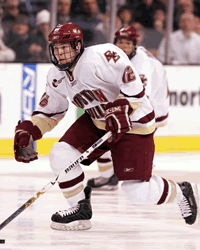 |
| Ben Smith had 50
points as a sophomore, after scoring just 18 points
in his freshman campaign. He's one of many talented
Eagles that can fill the void left by Nathan Gerbe. |
Gerbe's immediate impact was always at the
offensive end of the rink. He was a point-producer that
made his linemates better and was a scoring threat every
time he was on the ice. The Eagles will still return four
players that scored 35 points or more last season (Joe Whitney,
Ben Smith, Benn Ferriero, Brian Gibbons) and will also receive
a boost up front from the return of Brock Bradford who missed
most of the 2007-08 season due to injury.
That depth at forward and skill on the power
play makes Boston College dangerous. When opponents didn't
concentrate on Gerbe, he was an offensive force. When they
paid attention to Gerbe individually, BC's other lines and
other scoring options came through.
Goaltender John Muse proved that he was a
workhorse and was capable of winning the big games, even
when a defense corps was still finding its way amid injuries
and suspensions.
• Is Blake
Wheeler opting to turn pro before signing a contract with
the team that drafted him significant for college hockey?
This isn't Van Ryn II, is it?
Not at all. That said, Wheeler's case, an
unintended by-product of the most recent NHL collective
bargaining agreement, is extremely interesting.
Wheeler, you'll recall, was selected by Phoenix
with the fifth overall selection in the 2004 draft. According
to INCH's CBA wizard, since he spent one season with the
United States Hockey League's Green Bay Gamblers prior to
suiting up for Minnesota, it accelerated the Coyotes' window
of opportunity to sign him.
So what's the difference? Well, a team that
drafts a player prior to his freshman season in college
holds the rights to sign him until Aug. 15 of the year his
class graduates. For example, Philadelphia used its first-round
pick in 2007 on James van Riemsdyk, who was a rookie at
New Hampshire last year. The Flyers – or a club that
acquired JVR's rights in trade – would have an exclusive
negotiating window with him until Aug. 15, 2011. If he's
not signed by then, he'd become a free agent.
But since Wheeler went to the USHL the season
after he was drafted, then decided to leave Minnesota early
without a deal with Phoenix in place, a different set of
rules apply. First, since he was drafted prior to the expiration
of the old CBA, Wheeler is subject to those rules pertaining
to the rookie salary cap, which were far more lucrative
than the standards in place now. Second, by announcing his
decision to leave school, the Coyotes have 30 days to come
to a contract agreement with Wheeler. If the 30 days expires
and no contract is in place, Wheeler becomes a free agent
and Phoenix gets a second-round draft pick in this year's
draft (it would be the 35th overall, corresponding with
slot the Coyotes selected Wheeler in the first round in
'04.)
The kicker in this case – and it's unique
to this particular situation alone – is that Phoenix
could allow the 30-day window to close and get the second-round
pick as compensation, then sign Wheeler to a free agent
deal. That may cost Wheeler, however, since he no longer
would fall under the old CBA's entry-level salary standards.
This shouldn't open a Van Ryn-like can of
worms, but does provide an interesting option for those
prospects who spent an extra year in juniors after they
were drafted. College players who could face a similar decision
in the near future include Michigan State defenseman Jeff
Petry, Minnesota goalie Alex Kangas, and Notre Dame rearguard
Kyle Lawson.
• College hockey's
conferences are exploring different ways to determine winners
in tied games including implementing a shootout, extending
overtime periods, or changing the overtime format. What
are the ramifications if new rules are put in place?
The biggest concern that we have is that it
appears that each individual league may adopt different
overtime and tie-breaking policies. That could cloud the
comparisons that are used by the assorted computer ranking
systems that determine NCAA tournament at-large selections.
For example, if the NHL format was used in
one conference, where a five-minute 4-on-4 overtime is followed
by a shootout, a win is assured in every game. The losing
team would receive a point
Another league may adopt a 10-minute overtime
period that is used in some international competitions,
and then declare the game as a tied contest if no winner
is determined in the extra session. Some might opt for a
five-minute 5-on-5 overtime followed by a five-minute 4-on-4
period if no winner has been determined.
So what happens in non-league games? Preseason
and holiday tournaments? We respect that each league may
have a bit of a different look as they implement plans for
regular-season conference games, but there needs to be an
agreed-upon format for other games, and for how results
are interpreted by the NCAA selection committee and procedure.
• It's now
a foregone conclusion that at least one of the Hobey Baker
Award finalists from here on out will be from a team that
plays in what we lovingly refer to as a mid-major conference.
No complaint here; the four established leagues certainly
don't have a monopoly on talent. So who are the players
to keep on eye on during the upcoming season?
In Atlantic Hockey, it's Sacred Heart forward
Bear Trapp. In addition to having a name tailor-made for
a memorable Hobey PR blitz, he's got attention-grabbing
statistics, too. As a junior, the Regina, Saskatchewan,
native scored 40 points in 34 games. In 104 games over three
seasons, Trapp has tallied 46 goals and 77 assists for 123
points.
In the CHA, we like Robert Morris forward
Chris Margott. Playing alongside Ryan Cruthers, the league's
leading scorer, last season, Margott registered 18 goals
and 26 assists for 44 points. Cruthers, who scored 49 points,
had a Hobey-worthy campaign in his final season but wasn't
among the 10 finalists. Maybe Margott can help the Colonials
celebrate their fifth season of varsity hockey by being
part of that group.
• OK, smart guy, even though
we're 11 months from the 2009 Frozen Four, who are your
picks to advance to Washington D.C. next April?
If history tells us anything, there will be
at least one team from this year's Frozen at the Verizon
Center – it's happened in all but one year (2004 was
the exception) since 1992. We'll extend invitations to two
2008 participants, however – Boston College and Michigan,
teams that suffered a couple key losses, yet return with
virtually every key piece of the equation in place.
Each year, there seems to be at least one
darkhorse in the field. Notre Dame played the role in 2008.
Next year, how about Minnesota? With Wheeler's departure,
the Gophers lose five of their top six scorers from a year
ago. But with Alex Kangas solidly entrenched in goal and
a talented group of newcomers to mix in with the returning
cast, Minnesota should be able to steer clear of the pitfalls
that befell it last season.
There are compelling reasons to put Notre
Dame in this group, but since we're playing with house money,
we'll take a flier on Boston University (much to the chagrin
of our many Boston College e-mailers) provided the Terriers
find a capable goalie. We say capable because BU should
have the ability to score a ton of goals next season, and
its defensive corps should be one of the team's strengths.